Su carrito está vacío



Carrito
Jose and Francis paid off more than $30,000 in student loans and cleared their car debt three years early. Their story starts with a challenge familiar to many families: turning financial intentions into a plan they could follow.
There’s a thought that can follow you through an otherwise ordinary day.
We’re bringing money in. Why does getting ahead feel so difficult?
You might think about it on the drive to work. Or after paying another credit card bill. Or when a repair arrives just as you were hoping to make an extra payment.
From the outside, life looks steady. The bills are paid. There’s food in the fridge. Everyone gets where they need to go.
But part of every paycheck already belongs to something you bought, borrowed, or needed months ago.
You want that money back in your future. You just haven’t worked out exactly how to get there.
For Jose and Francis, becoming parents was a turning point.
Planning for their family gave them a reason to bring their different skills together.
Jose brought an engineering background, a master’s degree, and an enthusiasm for spreadsheets. Francis brought her nursing background and a focus on making the tools practical, understandable, and pleasant to use.
They also had their own financial hurdles. Through disciplined budgeting and the spreadsheets they created, they report paying off over $30,000 in student loans and finishing their car payments three years early.
Their experience is personal. It doesn’t tell you how quickly another household will repay its debts.
It does offer a useful starting point: put the numbers together, choose a plan, and give yourself a way to follow it.
Imagine you’re paying $400 toward one debt and $150 toward another.
Your total debt payment is $550 a month. Eventually, you finish paying the second balance.
What happens to its $150 payment?
You may need it for essential expenses or savings. But if your budget allows you to keep paying the same $550 toward debt, that money can move to the remaining balance.
The remaining debt could now receive $550 instead of $400.
Your total monthly debt budget stays the same. More of it is concentrated on the balance still standing.
It’s a simple decision. Over time, it can change the repayment path.
A similar opportunity can arise when a required minimum falls. If you can afford to maintain your planned payment, you don’t have to reduce it just because the amount due is lower.
The challenge is keeping track of those decisions across several balances—and seeing their estimated effect.
Consider a hypothetical $6,500 balance at a fixed 24% APR.
Under a simplified monthly-interest model, the first month adds $130 in interest. A $150 payment reduces the original balance by only $20.
Increase that payment to $200, and the first month’s principal reduction becomes $70.
The payment increased by $50. The amount reducing the original balance rose from $20 to $70.
$150 monthly payment
102 months
Estimated payoff time
About $8,763 in interest
$200 monthly payment
54 months
Estimated payoff time
About $4,103 in interest
In this example, the additional $50 each month means 48 fewer months of payments and approximately $4,660 less interest.
Illustration uses a fixed 24% APR, monthly interest at APR ÷ 12, month-end payments, no fees, and no new borrowing. Final payments are smaller. This is an independent calculation, not a customer result or a demonstration of the product’s exact calculation model. Actual account calculations and outcomes vary.
Your balances, rates, and available payments will produce a different result.
The useful question is what a realistic change could do with your numbers.
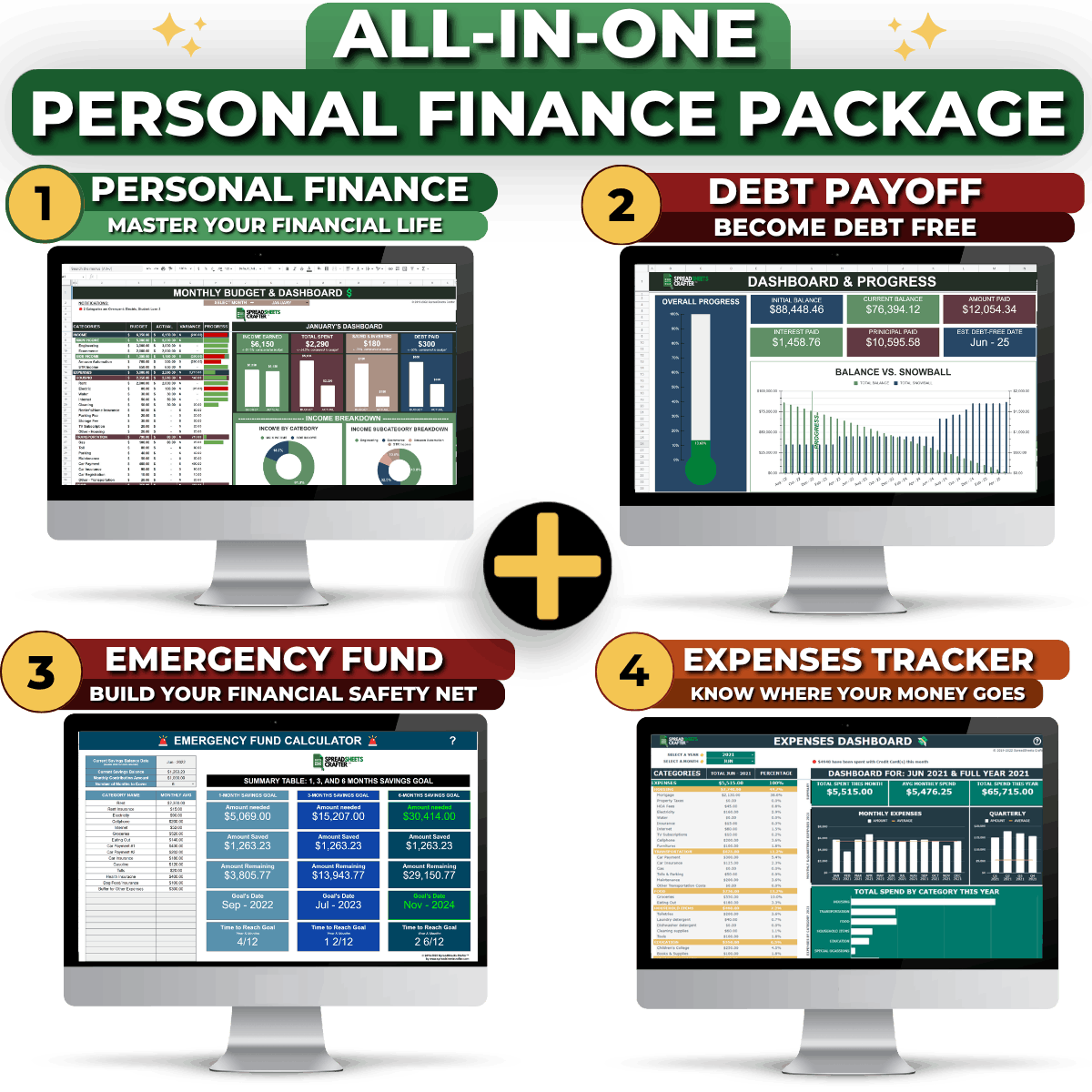
The Debt Payoff Calculator and Tracker helps you organize your debts and explore a repayment plan.
Bring together your balances, interest rates, and minimum payments. Compare snowball and avalanche strategies. Review an estimated completion date based on what you enter.
You can also add extra payments and examine the projected effect.
That gives you something more concrete to discuss than “we should probably pay more.”
You can review an amount, look at the estimate, and decide whether it fits your household.
Two repayment approaches to compare. Explore snowball and avalanche using your debt information.
A payment schedule and estimated finish date. See a projected path based on your inputs.
A place to explore additional payments. Review how contributing more could affect your plan.
A view of principal, interest, and progress. Follow balances with graphs and progress bars.
Excel and Google Sheets versions. Includes instructions, a currency selector, and lifetime updates. One purchase. No subscription.
Picture your next conversation about debt.
You have the balances in front of you. You know which account you’re focusing on. You’ve chosen a payment amount that fits the budget.
If something changes, you have a plan to revisit.
If progress feels slow, you have a record to review.
And when a debt is cleared, you can decide what happens to that payment before it disappears into everyday spending.
Those are practical decisions. Making them together can give your next money conversation a clearer starting point.
Start by gathering the information you already have: your balances, rates, and minimum payments.
Enter the numbers. Compare the available approaches. Review what the estimates suggest.
Then choose your next step with your actual household budget in mind.
You may have room to increase payments. You may need to focus on maintaining what you already pay. Your plan should reflect that reality.
Give the effort you’re already making a direction you can follow.
One-time purchase · Excel and Google Sheets · No subscription